Install Python and VS Code, run your first program and learn to read error messages.
Introduction to Big Data with Python
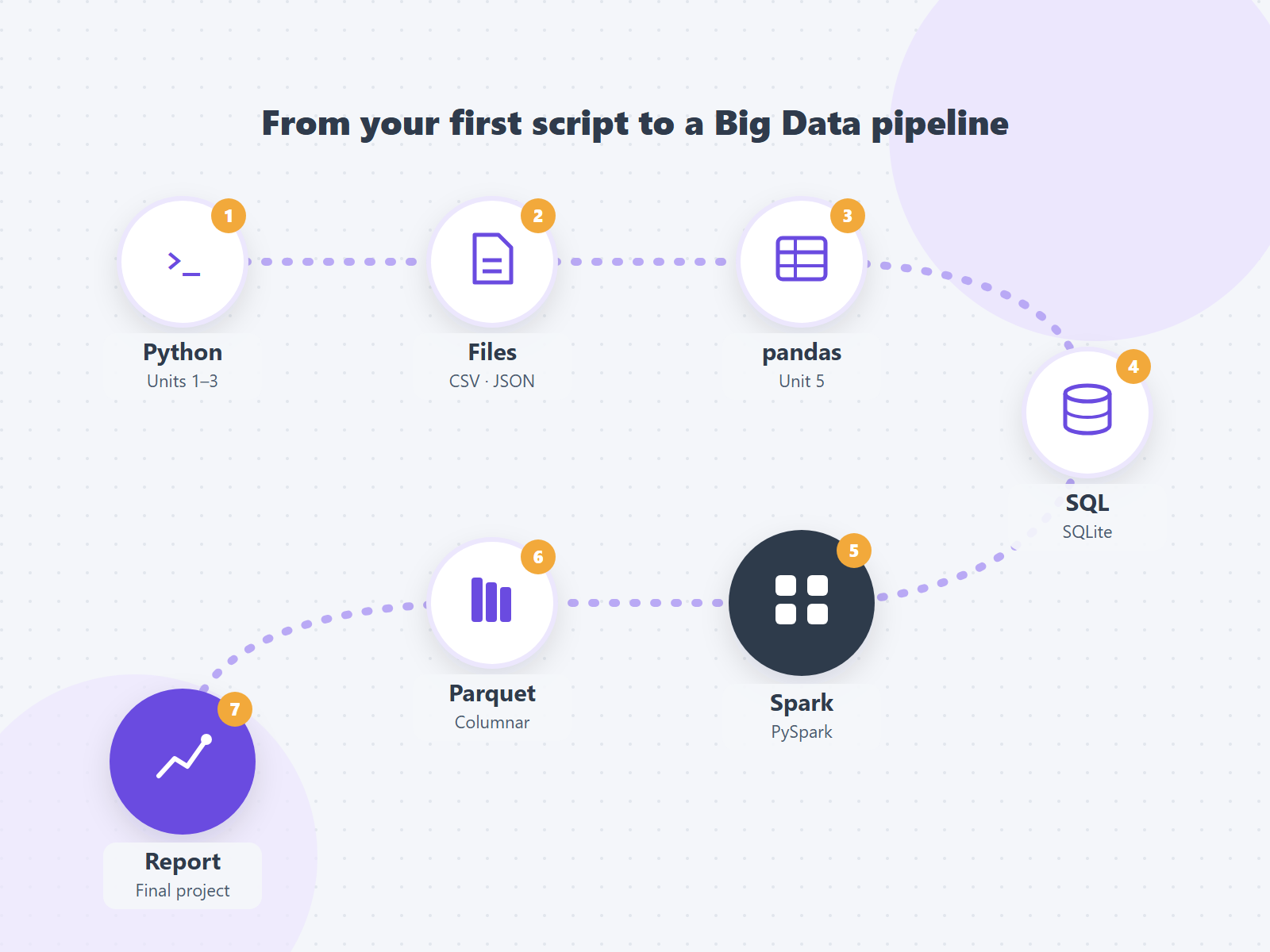
From your first Python program to a full Big Data pipeline in PySpark. No programming experience needed: you build up one step at a time, with a project in almost every unit.
Beginner to intermediate
Why this course is built this way
Most Big Data courses start with Spark. This one starts with Python and conventional data processing: files, pandas and SQL. Then it asks a simple question: what happens when the data no longer fits on your computer? By the time you use Spark, you know exactly what problem it solves.
- Basic computer literacy is the only prerequisite
- You work in VS Code with Python, the same set-up used in industry
- Each stage ends with a mini-project you can keep
- The course closes with an end-to-end ETL project
14
Units
16
Learning outcomes
7
Mini-projects
1
Final project
raw data to report
What you will be able to do
- Write Python programs and organise a project in VS Code
- Read and write text, CSV and JSON files
- Analyse datasets with pandas
- Design a relational database and query it with SQL
- Connect a Python application to SQLite
- Explain why Big Data needs distributed computing: clusters, nodes, partitions
- Load and process data with PySpark, Spark DataFrames and Spark SQL
- Work with Parquet and other Big Data formats
- Build a data-processing pipeline from raw data to analysis
The 14 units
Unit 1
Development environment and introduction to Python
Unit 2
Python fundamentals
Variables, conditions, loops, functions and exceptions. Project: a student grade analyser.
Unit 3
Python data structures
Lists, tuples, dictionaries, sets and comprehensions. Project: an in-memory student management system.
Unit 4
Working with files
Text, CSV and JSON. Project: a data processor that turns raw files into clean reports.
Unit 5
Data analysis with pandas
DataFrames, filtering, grouping, aggregation and merging. Project: an e-commerce data analysis.
Unit 6
Databases and SQLite
Tables, keys and relationships. Project: design and build a school database.
Unit 7
SQL
SELECT, aggregation, GROUP BY, JOIN and data changes. Project: school analytics in SQL.
Unit 8
Python and SQLite
Send SQL from Python and work with the results. Project: a student database application.
Unit 9
Introduction to Big Data
Volume, velocity and variety. Process files of growing size and see where a single computer struggles.
Unit 10
Distributed computing
Clusters, nodes, partitions and fault tolerance. Simulate distributed processing in plain Python.
Unit 11
Introduction to PySpark
SparkSession, DataFrames and schemas. Project: your first PySpark data analysis.
Unit 12
Spark DataFrames and transformations
Transformations, actions and lazy evaluation. Join customers, orders and products.
Unit 13
Spark SQL and Big Data formats
Query DataFrames with SQL and compare CSV with Parquet for size and speed.
Unit 14
ETL and final Big Data project
Ingest, clean, transform, store and analyse a global e-commerce dataset, then present your results.
How you are assessed
Marks are spread across the course, so steady work counts.
Python and files: 20%
Python exercises (10%) and the file-processing project (10%).
Data and databases: 25%
Pandas data analysis (10%) and the SQL and database project (15%).
Big Data: 25%
Big Data exercises (10%) and PySpark assignments (15%).
Final project: 25%
Your end-to-end pipeline: code, SQL, results, a README and a short presentation.
Participation: 5%
Taking part in live sessions and challenges.
Questions about this course
No. The course starts from zero: installing Python and writing your first program. Basic computer literacy is enough.
A computer on which you can install Python, VS Code, SQLite and PySpark. All of them are free. Unit 1 walks you through the installation.
In blended format: live sessions with a teacher, plus lessons, exercises and projects on our learning platform between sessions. Live sessions are timetabled for each group, and you receive the timetable when you join.
Start dates are set for each group. Sign up or contact us and we will tell you when the next group starts.
Contact us for the current fee and the payment options.